
Use Bind’s A and B entrances and one-way teleporters to practise callouts, rotations and retakes.
Bind has two sites, A and B, and no traditional mid lane. Start by separating confirmed enemy positions from guesses, noting your teammates’ locations and the teleporter exits. Before a retake, regroup and check the route; do not leave the other site empty because of one footstep.
This guide uses Bind in Riot’s 13.08 Competitive map pool as an example. Map rotations change, so check the mode and map shown in game.
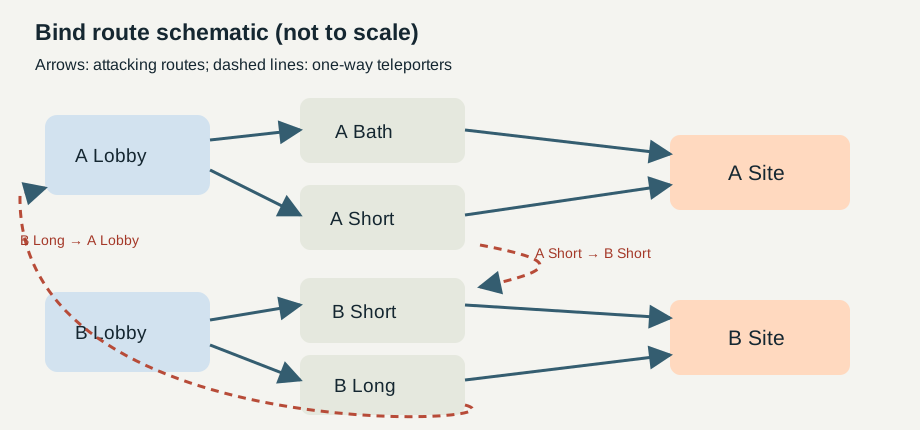
This original schematic shows the main routes and teleporter directions only; it is not a scale map. Check cover, distances and defender spawn on the in-game map.
Attacking: call confirmed information first
On A, teams commonly approach A Site through A Short or A Bath/Showers. On B, they can approach B Site via B Short/Window or B Long. The entrances meet near the site, but walls may prevent teammates on separate routes from trading shots immediately.
One opening example is two players watching near A Short, one watching A Bath and two scouting B. Treat this as a starting division and adjust for your team and utility. When you spot opponents, say “two seen at A Short, one backed away” rather than turning one footstep into “all five are A”. Enemy abilities and footsteps can be a fake.
When attackers group up, the Spike carrier should stay with the team while teammates check near corners and their own readiness. If the lead player has fallen back to heal or a flash is not ready, pause behind cover and reset the timing.
Rotating: fast teleporters have fixed directions
The A Short teleporter leads toward B Short; the B Long teleporter leads toward A Lobby. They are not two-way doors: you cannot return through the exit. Teleporting makes a noticeable sound and the exit may be held, so a fast rotation is not necessarily safe.
For example, if multiple defenders hold A Short, check the B entrance and teleporter exit with the teammates on B before deciding whether the Spike carrier should teleport or retreat along the original route. Announce that you are about to go through, clear the exit on the other side, then inform those still waiting. If the exit is threatened, the players behind should not blindly follow just because the first group entered.
Defending: confirm the Spike and numbers before rotating
At the start of defence, place observers on both A and B, with the remaining player able to move. Adjust for enemy habits, utility and team communication. The first player to make contact should report the entrance, enemy count, whether the Spike was seen and whether they can retreat.
Suppose B teammates see several attackers coming through B Long and confirm the Spike. Leave the necessary rear observation on A while the other teammates move toward B by safe routes. During the retake, check the minimap: who remains on B, who can provide a flash and who can engage from another entrance at the same time? Avoid crossing the doorway alone and letting enemies eliminate you one by one.
After the Spike is planted, listen to teammates’ confirmed enemy positions, use utility to clear near corners and agree to act from both sides together. Check the defuse tool, remaining time and nearby cover. When information is poor or the numbers disadvantage is severe, decide whether to save your weapon based on time and economy.
Common mistakes
- Everyone rotates on one sound: distinguish what was seen from what was heard and keep someone watching the other side.
- Treating the one-way door as a safe shortcut: check the exit with teammates on the other side before entering.
- Retaking one at a time: wait until teammates who can trade are in position, then count down and move together.
- Ignoring the flank after entry: assign players to watch secured entrances and uncleared corners rather than having everyone turn their back on the same direction.
For Skye and duelist entry coordination, see How to coordinate Skye’s flash for an entry in VALORANT: Bind A Short; for economy purchases, see VALORANT economy guide: pistol rounds, saving and full buys.
Sources
Revision history
— Recently updated